
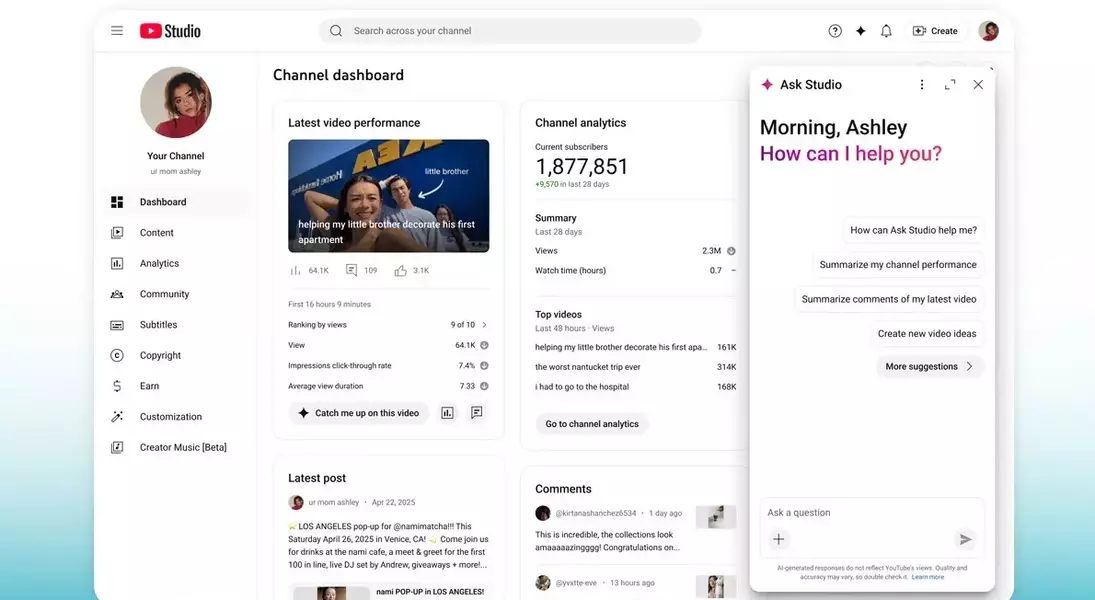
YouTube is transforming the landscape for content creators by integrating advanced artificial intelligence into various stages of content production. These new tools aim to streamline the often-complex backend work that goes into creating engaging videos, from analytics and content strategy to global reach through enhanced dubbing. This marks a significant shift in how social media platforms are directly empowering creators with sophisticated technology, fostering both efficiency and optimized audience engagement.
YouTube's New AI-Driven Creator Toolkit Unveiled at 'Made On YouTube' Event
During the 'Made On YouTube' event in New York on Tuesday, September 16, 2025, YouTube introduced a range of innovative AI features tailored for content creators. These tools are primarily designed to simplify the intricate processes involved in video production and audience analysis, which historically have been manual and time-consuming. Mia Sato reports that these features extend beyond previous AI offerings, such as background music generators or AI-driven photo and video creation, to focus on strategic content development.
One of the flagship tools is Ask Studio, an AI chatbot serving as a 'creative partner' for creators. This chatbot allows users to query analytics about their content's performance, identify compelling video moments, and summarize viewer sentiment from comments across both long-form videos and Shorts. Furthermore, Ask Studio can suggest improvements based on data, offering advice to optimize sections with low viewership and generate video ideas and title suggestions from audience feedback. However, it currently does not support competitive analysis queries.
YouTube is also rolling out an advanced thumbnail and title A/B testing feature. Building on a thumbnail-only testing version launched last year, this update enables creators to test different combinations of thumbnail images and titles to determine which garners the highest watch time. Lifestyle influencer Ashley Alexander, an early tester, emphasized the critical role of thumbnails and titles in attracting viewers and noted her adoption of this new A/B testing in her workflow.
Beyond behind-the-scenes tools, YouTube is enhancing its viewer-facing AI features. The existing auto-dubbing feature will now include lip-syncing to match the dubbed language, improving the viewer experience for international audiences. Videos utilizing this feature will display a badge indicating auto-dubbing, though creators cannot manually edit mis-translated segments. Additionally, YouTube is introducing a multi-collaborator feature, allowing multiple creators to work on a single video and access shared performance metrics.
This wave of AI integration follows a broader trend across the content creation industry, where AI assists with various aspects, from adult content creators using chatbots for client interactions to advertisers employing AI-generated models. While YouTube previously updated its monetization policies to address 'inauthentic content'—often interpreted as mass-produced AI videos—the platform now provides direct AI assistance. This raises questions about how creators can maintain originality and audience connection if all are optimizing content using the same algorithmic suggestions, potentially leading to a homogenized content landscape.
The increasing reliance on AI tools by platforms like YouTube presents a dual-edged sword for content creators. On one hand, these innovations promise to democratize access to sophisticated analytics and creative assistance, potentially leveling the playing field for smaller creators and freeing up time from mundane tasks. For many, including influencer Ashley Alexander, AI serves as a powerful springboard for ideas rather than a definitive creative blueprint. The notion that AI can suggest a video concept or optimize a title allows creators to focus their human ingenuity on execution and building authentic connections, which AI cannot yet replicate. However, this raises important questions about the future of creative independence and content diversity. If algorithms dictate optimal content strategies, will it inadvertently lead to a homogenization of popular content, where everyone strives for the 'perfect' AI-approved video? The challenge for creators, moving forward, will be to skillfully integrate these powerful tools while fiercely protecting their unique voice and artistic integrity, ensuring that technology remains a servant to creativity, not its master.